
NaftalanNaftalan WikiNaftalan oil
Naftalan oil
Naftalan oil
A medicinal crude that does not burn and is extracted on an industrial scale in one place on earth — everything the Naftalan resort does rests on it.
- What it is
- A non-burning medicinal oil rich in naphthenic hydrocarbons
- Where it comes from
- The town of Naftalan — the only industrial field of its kind
- Bath temperature
- 37–38 °C, close to body heat
- One session
- up to 10 minutes, then at least 40 minutes of rest
- A course
- at least 10 sessions, usually over 10–14 days
- Repeating it
- no sooner than six months later, on a doctor's advice
Naftalan oil is a medicinal crude that does not burn and is extracted on an industrial scale in one place on earth. What it is, how it acts, which complaints it is prescribed for, in what forms it is used and who it does not suit — all on one page.
What naftalan oil is, in plain words
Naftalan oil is a thick, dark natural crude with a smell of its own. What sets it apart from ordinary oil is that it does not burn: the light fractions that make a fuel are practically absent. For more than a century it has been extracted not to be burned but to be used in treatment — as baths, as applications and as the base of pharmacy preparations.
On an industrial scale, a deposit of this type exists in one place on earth, around the town of Naftalan in Azerbaijan. "Naftalan" is the name of both the oil and the town, and preparations sold in other countries are made from raw material that leaves this field.
Composition: how it differs from ordinary oil
The difference is chemical. In naftalan oil the share of naphthenic hydrocarbons is high, where ordinary crude carries far less of them, and it is these components that the therapeutic effect is attributed to. The absence of petrol and other light fractions is why the oil does not burn and why it behaves more gently in contact with skin.
The oil used in treatment does not go from the well into the bath: it is purified, prepared, and only then warmed to the prescribed temperature.
How naftalan acts
The effects observed are these: inflammation subsides, pain eases, the vessels near the surface of the skin widen and circulation improves, joints move more freely, muscle tension drops. The warmth of the bath adds to that, which is why the procedure is run close to body temperature.
Not every detail of the mechanism has been worked out, and that is worth saying plainly. What is clear in practice is that the result accumulates over a course rather than in one session, and that naftalan does not replace your main treatment — it sits alongside it.
The benefit and the harm: indications and contraindications
On the benefit side are the studied effects on the body — inflammation and pain subside, circulation improves, joints move more freely; these are the therapeutic properties naftalan is described by, and the indications follow from them. The harm almost always comes from misuse: an unsupervised temperature, a session run too long, a procedure taken in an acute phase, an intolerance nobody checked. That is why the indications and the contraindications have to be read together — see the section below.
What naftalan is used for
The areas it is prescribed for most often:
Joints and the spine — osteoarthritis, arthritis, rheumatoid complaints, osteochondrosis, back and neck pain. "Naftalan for joints" is the most asked question, and in practice it is the largest group.
Skin conditions — psoriasis, eczema, neurodermatitis and some dermatitis. Here it is used under a dermatologist's eye.
Nerve pain — neuralgia, neuritis, sciatica.
Recovery after injury and surgery — at the stage of restoring range of movement and reducing pain.
Gynaecological and urological programmes — as procedures of their own, on the relevant doctor's prescription.
With something like a spinal disc herniation, naftalan is not a treatment in itself: it may act on the pain and the inflammation, but the decision belongs to the doctor reading your imaging.
The forms it is used in
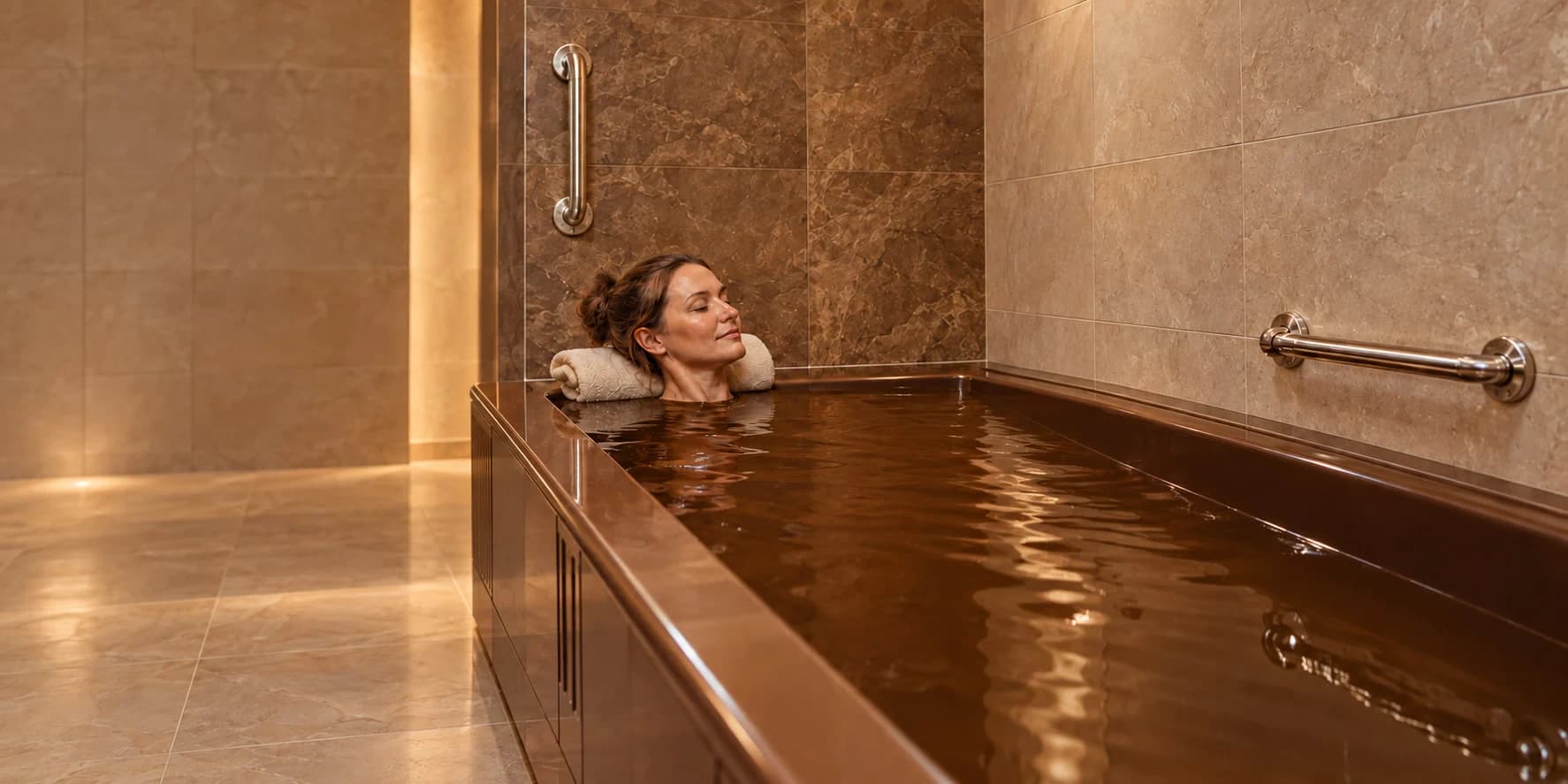
The best-known form is the full-body bath — the oil is warmed to 37–38 °C and the session lasts up to ten minutes. Beyond that there is the sitz bath (to the waist), the local bath for the lower limbs, the four-chamber bath for the limbs separately, and the application, laid on a limited area of the body. Naftalan is also used alongside certain physiotherapy procedures.
After a session the oil is washed off in the shower and at least forty minutes of rest follow — that rest is part of the protocol, not an optional extra. A course usually runs to at least ten sessions over 10 to 14 days, and a repeat course is not planned sooner than six months later.
Naftalan ointment: what it is and how it differs from the bath
Most people meet naftalan first in a chemist rather than in a bath: naftalan ointment, naftalan cream, shampoo and gel are the forms most widely sold. They come from the same raw material, but they are not the same treatment.
What naftalan ointment is made of
Pharmacy preparations are usually based on deresined naftalan — the crude with part of its irritant components taken out. How much naftalan an ointment actually contains varies by manufacturer, so two different ointments are not the same thing.
Naftalan ointment for psoriasis and for joint pain
These are the two uses asked about most: skin complaints (psoriasis, eczema, dermatitis) and joint and muscle pain. An ointment acts on a limited area and is meant for daily use at home; a bath covers the whole body, runs as a course and is given under medical supervision. The result and the risk are not on the same scale.
Instructions and use: who decides
Every preparation carries its own instructions in the box, and we publish no dose, frequency or duration here — that is for your own doctor to set, particularly where a skin disease, pregnancy or a child is involved. We sell no ointment, cream or shampoo and recommend no brand.
Can you take a raw-oil bath at home?
It is not advisable. With the temperature, the duration and the number of sessions unsupervised, you do not even get what an ointment gives you — what remains is the risk of skin irritation, an allergic reaction and a flare-up. A sanatorium bath differs precisely in that those three are chosen by a doctor.
Contraindications, and the harm
Naftalan does not suit everyone. Among the contraindications are acute inflammation and fever, malignancy, severe heart and kidney failure, a tendency to bleeding, pregnancy and individual intolerance — and the list is not exhaustive. Blood pressure, heart rhythm, thyroid and the state of the skin are each assessed separately.
Used wrongly it can bring skin irritation, an allergic reaction, dizziness or a flare-up of the original complaint. That is exactly why a course opens with an examination and, where needed, tests, and why the number of sessions, the temperature and the duration are set by a doctor.
Three common misconceptions
"One bath is enough" — no. The effect builds over repeated sessions, and feeling no change in the first days is normal.
"Naftalan cures everything" — no. It reduces pain and inflammation in some complaints and is not prescribed at all in others. A source that guarantees a cure has told you something about itself with that promise.
"It can be taken internally" — no. Naftalan oil is for external use; it is not swallowed.
To find out whether naftalan suits your case, write to us with your complaint and any test results; our doctors can say before you travel whether a course fits and roughly how long it should be. For the town the oil comes from, see Naftalan city.
Gallery
Naftalan oil
Services
The treatments that use naftalan oil
The oil is not given in one form only: a full bath, a sitz or local bath, an application, gynaecological and urological programmes — which of them suits you is for the doctor to say after an examination.
Naftalan treatment
The treatment itself: a course of 10 to 14 days, built out of several procedures after a doctor has examined you.
Full-body naftalan bath
The principal procedure, the body immersed fully in naftalan oil — on prescription.
Naftalan sitz bath
A bath to the waist, used in programmes directed at the pelvic area.
Local naftalan bath (lower limbs)
A local bath immersing a foot or a single limb.
Naftovit application (natural naftalan oil)
Local application of a product made from natural naftalan oil — year-round, under supervision.
Joint and spine treatment with naftalan
A programme of naftalan baths, physiotherapy and movement therapy for osteoarthritis, arthritis, osteochondrosis and back or neck pain.
Skin and psoriasis treatment with naftalan
A programme of naftalan baths and applications for psoriasis, eczema and dermatitis, under a dermatologist's eye.
Gynaecological treatment with naftalan
A gynaecological programme built on naftalan applications, after examination.
Urological treatment with naftalan
A urological programme built on naftalan applications and rectal procedures.
Infrared therapy with naftalan
Infrared radiation used together with a naftalan application.
Four-chamber naftalan bath
A local bath with the hands and feet in four separate chambers, used where the full bath is contraindicated.
Questions and answers